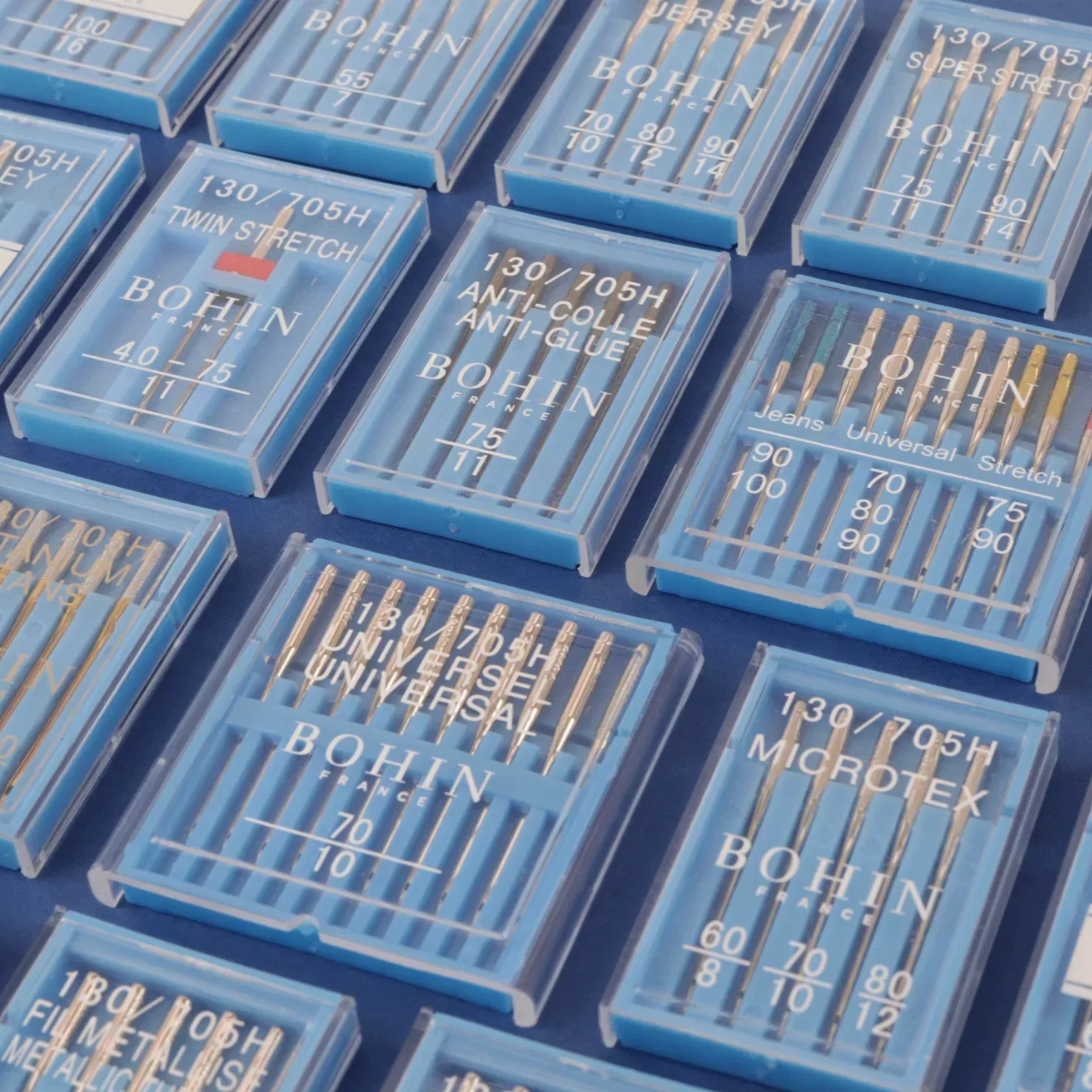
Different types of machine needles and their uses.
A needle suitable for the fabric ensures a cleaner result, prevents skipped stitches, reduces the risk of breakage, and preserves the fabric fibers.
In this guide, we help you choose the right needle for your fabric, its weight, and your sewing project.
Universal needles: for woven fabrics
Universal (or standard) needles are designed for non-stretch fabrics, also known as woven fabrics.
These fabrics are woven from warp and weft threads and have a grainline. Among the most common are:
- poplin;
- cotton fabrics;
- cretonne;
- pique;
- terry cloth;
- flannel;
- batiste;
- velvet;
- voile;
- twill;
- canvas;
- satin.
They can be made of cotton, linen, polyester, viscose, or other fibers.
As long as your fabric does not have elasticity in the grainline, you can use a standard machine needle. These needles offer an excellent compromise between strength and flexibility thanks to their specific treatment.
What needle size to choose?
The advantage of universal needles is that they come in many sizes.
To get started, the easiest way is to use an assortment including the three most common sizes:
| BOHIN Size | Singer Size | Use |
|---|---|---|
| 70 | 10 | light fabrics |
| 80 | 12 | medium fabrics |
| 90 | 14 | medium to heavy fabrics |
This assortment covers most fabrics between 100 and 250 g/m².
Correspondence between fabric weight and needle size
BOHIN universal needles are available in sizes 55 to 120.
Size 55 (Singer 7)
For extremely fine and delicate fabrics:
- muslin;
- voile;
- silk.
Size 60 (Singer 8)
- single gauze;
- voile;
- fabrics under 120 g/m².
Size 70 (Singer 10)
For light fabrics (up to 150 g/m²):
- double gauze;
- viscose crepe;
- batiste.
Size 80 (Singer 12)
For medium fabrics (150 to 200 g/m²):
- poplin;
- classic cottons.
Size 90 (Singer 14)
For slightly heavier fabrics (200 to 250 g/m²).
Size 100 (Singer 16)
For heavy fabrics (250 to 350 g/m²).
Size 110 (Singer 18)
For very heavy fabrics (350 to 400 g/m²).
Size 120 (Singer 19)
For the thickest fabrics (over 400 g/m²), provided your machine has a suitable motor.
Tip: finding the size of a needle
Have you removed a needle from its packaging?
The size is engraved directly on the needle shank. The inscription can sometimes be difficult to read but is visible with good light or a magnifying glass.
Special needles: real sewing comfort
Some fabrics or techniques require specific needles.
Contrary to popular belief, these needles are not reserved for experienced sewers. On the contrary, they make sewing easier and help achieve a better result more quickly.
Leather needle
Leather needles have a special point that allows them to directly perforate the material.
They are ideal for:
- leather;
- oilcloth;
- coated fabrics.
Unlike an awl, they perforate cleanly without leaving embossing marks.
For even greater comfort, use a Teflon foot to promote material glide.
For thread, prefer:
- a special denim thread;
- or a very strong cotton thread.
Waxed thread is not recommended for machine sewing.
Stretch needle
Stretch fabrics contain elastic fibers such as:
- elastane;
- lycra;
- nylon;
- some polyesters.
They are stretchy in all directions.
Stretch needles benefit from a special treatment that gives them more flexibility while maintaining their strength. This limits the risk of breakage due to the tension exerted by the fabric.
Twin Stretch needles
Twin Stretch double needles make it easy to create:
- hems;
- double topstitching;
- finishes on sportswear.
The BOHIN size is 75 (Singer 11).
On the top, the seam has two parallel lines. On the bottom, it looks like an overlock stitch made with a single bobbin.
Jersey needle
Jersey is a knitted rather than woven fabric.
Its particularity is that it is mainly stretchy in the direction of the selvedge.
Jersey needles have a rounded point that passes between the stitches without damaging them, thus preserving the elasticity of the fabric.
Twin Jersey needles
The BOHIN Twin double needle size 80 (Singer 12) is ideal for:
- t-shirt hems;
- parallel seams;
- garments made from medium-weight jersey.
Denim needle
Denim has a particularly tight and resistant weave.
BOHIN denim needles size 100 (Singer 16) allow for:
- assembly;
- topstitching;
- repairs;
- thick hems;
- attaching pockets and waistbands.
For stretch jeans, some assemblies can be made with a size 90 stretch needle, but the denim needle is still recommended for thicker areas and topstitching.
Anti-glue needle
When working with:
- adhesive sprays;
- textile glues;
- hook-and-loop fasteners;
glue residues can clog the needle and the machine.
Anti-glue needles have a non-stick coating that ensures excellent glide even on glued surfaces. They are particularly popular for:
- appliqués;
- patchwork;
- temporary stabilization work.
Patchwork needle
Patchwork needles have a fine point that allows for short, precise, and strong stitches.
They are suitable for:
- making the quilt top;
- quilting;
- wadding;
- free-motion quilting.
For thick quilts, it is also possible to use universal needles in sizes 100, 110, or 120, depending on the machine's capabilities.
Embroidery needle
Embroidery needles have an enlarged eye to facilitate thread passage.
The BOHIN assortment includes:
- size 75 (Singer 11): fine embroidery;
- size 90 (Singer 14): thick fabrics and denser threads.
BOHIN also offers needles specially adapted for metallic threads to limit the risk of breakage.
Microtex needle
Microtex needles are designed for technical and delicate non-stretch fabrics.
They are particularly suitable for:
- microfibers;
- fluid viscoses;
- delicate satins;
- tent fabrics;
- kites;
- paper piecing in patchwork.
Available in sizes 70, 80, and 90, they often provide the ideal solution when standard needles reach their limits.
What about viscose?
Viscose seduces with its softness, fluidity, and drape.
But it is also a material that can sometimes be delicate to sew.
Some tips:
- pin carefully;
- lightly starch the fabric if necessary;
- use a Microtex needle adapted to the fabric weight.
The BOHIN Microtex assortment includes standard sizes 70, 80, and 90, making it easy to choose the right needle for the fabric thickness.
In summary
For woven fabrics, a universal needle adapted to the fabric weight is sufficient in most cases.
As soon as you are working with a particular material (jersey, stretch, denim, leather, viscose...) or a specific technique (embroidery, patchwork, quilting), using a specialized needle significantly improves sewing comfort and the quality of the final result.