Sewing Machines: How to Choose Your Needles?
Confused by the multitude of machine needles? Don't panic!
Needles for domestic sewing machines are standardized. Whatever your machine (Singer, Brother, Bernina, Pfaff…), BOHIN needles with a flat shank are compatible with the vast majority of models.
The BOHIN range offers a wide choice of needles to suit all your projects and all types of fabric.
The key thing to check: the shank!
This is the part that inserts into the machine. Flat shank needles (the most common reference 130/705H) are suitable for most electric domestic sewing machines less than 60 years old.
💡 A needle is composed of a shank, a shaft, and a point with an eye (where the thread passes).
For example, if your machine uses 130/705H needles, then BOHIN needles are perfectly compatible.
Tip: this reference is usually indicated on the needle case supplied with your machine.
Which sewing needles for which use?

Now that you've chosen the right type of needle, you still need to define the right size.
It depends on your project:
- the fabric (material + thickness)
- the thread used
- and especially... the number of layers
You almost never sew just one layer: always think about the whole thing (fabric + lining + batting...). It's this overall "volume" that counts.
💡 The right thing to do: test on a scrap piece.
This allows you to adjust the needle, thread tension, and stitch.
We often speak of fabric weight rather than actual thickness, especially in the presence of batting.
And most importantly: sewing is not an exact science.
Recommendations are indicative — nothing replaces experience!
What do the "sizes" on needle cases mean?
The diameter of machine needles is expressed using two systems:
The international system (in hundredths of a millimeter)
- 55 = very fine (delicate fabrics like silk)
- 120 = very thick (upholstery, multiple layers)
The Singer system
- 55 = size 7
- 120 = size 19
💡 The two systems correspond perfectly to each other for needles of the same type.
At BOHIN, both sizes are indicated on the needle cases to help you easily find your way.
Which needles to use when starting machine sewing?
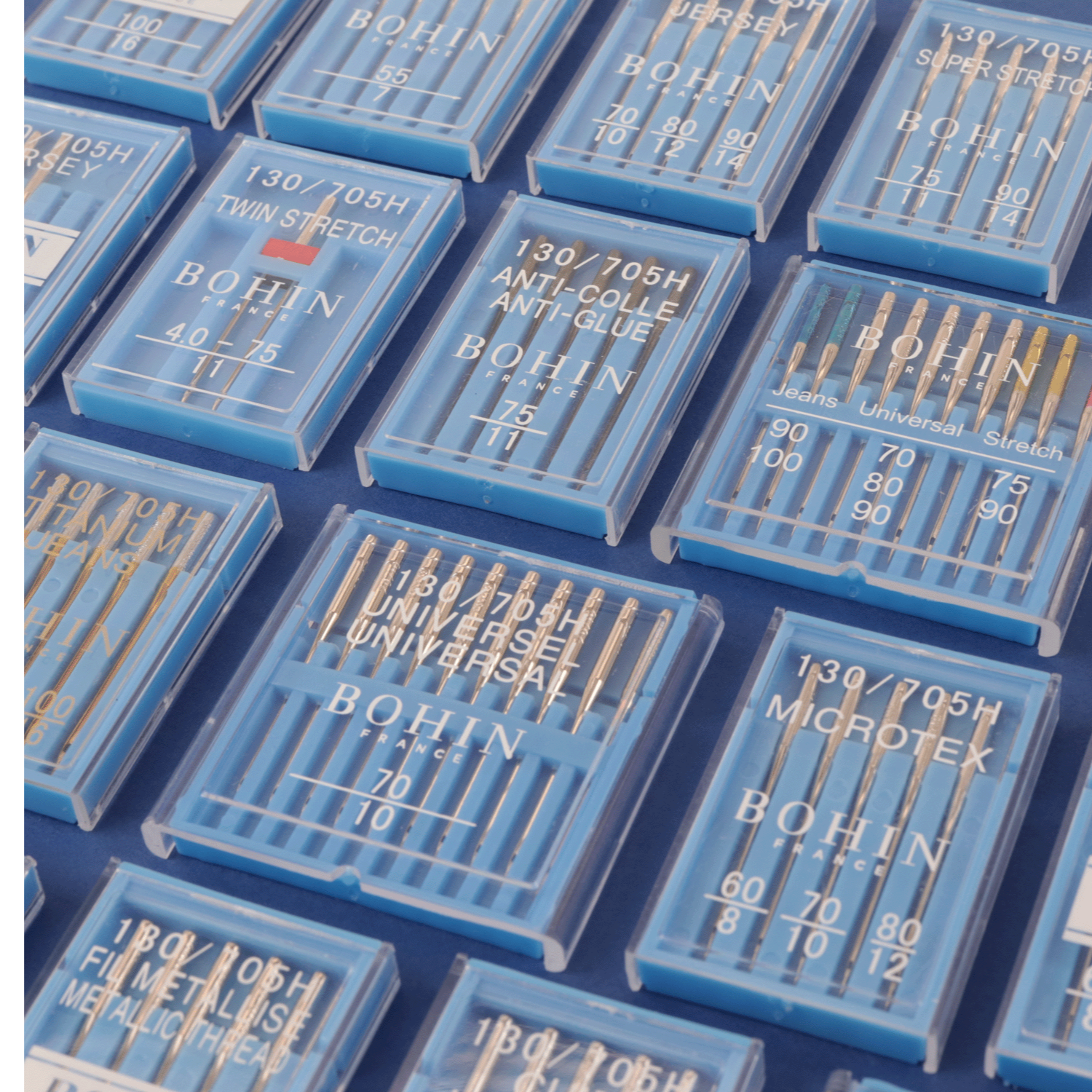
To get started, the ideal is to choose a machine needle assortment. This allows you to test different sizes and points depending on your projects.
Combined assortments include:
- standard needles (70, 80, 90 / Singer 10, 12, 14)
- jeans needles (blue – sizes 90 and 100)
- stretch needles (yellow 75 / Singer 11 and pink 90 / Singer 14)
💡 Perfect for discovering various uses and adapting to different fabrics.
If you only sew non-stretch fabrics, opt for a standard needle assortment:
- 5 needles: for occasional use or small projects
- 10 needles: for longer projects (clothing, complete pieces)
One needle may sometimes be enough for a project... but for larger works (coat, dress, trousseau), it is often necessary to use several.
Finally, assortments of needles with special points are ideal for expanding your possibilities: jersey, stretch, jeans... it's up to you!
Needle Usage Time
The needle point dulls over time. On average, a high-quality sewing needle is considered to have an optimal lifespan of 8 hours. Beyond these 8 hours, the point is less effective. Your stitches will be less even. If used for too long, your needle may break and even damage your sewing machine.
Maintenance of your sewing machine
It is advisable to have your sewing machine serviced annually (as you would your car) if you use it regularly. Also remember to clean it of textile dust that accumulates inside and oil the gears.
Storing your sewing needles
A machine needle has an average lifespan of approximately 8 hours of sewing. Beyond that, the point dulls and can affect the quality of your stitches.
The right thing to do: organize your needles to distinguish new ones from used ones.
Several simple solutions:
- create a needle book clearly noting the size and point type
- set up visual identification in your case (for example, by orienting used needles differently)
💡 In addition to being practical, making a needle book is an excellent DIY project for beginners!